The Hidden Cost of Running a Household
Running a household eats more time than people realize. Here is how many hours per week go to invisible domestic labor — and what you can do about it.

The beta is open — hand this off to Jipsa. Free to start, no card required.
Sign Up for BetaMost people think of household management as a few simple chores. Wash some dishes, pick up groceries, maybe cook dinner. But when you actually add up every planning decision, every errand, every logistical micro-task that keeps a home running, the number is staggering.
The average American household spends between 20 and 30 hours per week on domestic labor. That is not a typo. When you factor in the invisible work -- the planning, the remembering, the coordinating -- managing a home is practically a part-time job.
And it is a job nobody is paying you for.
The Time Audit Nobody Wants to Do
Let's break it down. Here is where those hours actually go each week for a typical two-person household:
Meal planning and grocery shopping: 5-7 hours. This includes deciding what to eat (often the hardest part), checking what you already have, building a list, traveling to the store or placing a delivery order, comparing prices, and putting everything away. If you cook most meals at home, add another 7-10 hours for actual food preparation and cleanup.
Scheduling and coordination: 2-3 hours. Doctor appointments, vet visits, car maintenance, social plans, kids' activities if you have them. Each one requires research, phone calls or online booking, calendar checking, and often rescheduling.
Cleaning and household maintenance: 3-5 hours. Laundry, vacuuming, dishes, tidying, taking out trash, seasonal tasks like changing air filters or cleaning gutters.
Financial management: 1-2 hours. Paying bills, reviewing subscriptions, budgeting, tracking expenses, filing paperwork.
Errands and miscellaneous: 2-4 hours. Returning packages, picking up prescriptions, dropping off dry cleaning, waiting for the repair technician.
Add it all up and you are looking at 20-31 hours per week. For households with children, that number can double.
The Mental Load Problem
The hours listed above only capture the visible work. What they miss is the cognitive overhead -- what researchers call the "mental load."
The mental load is the constant background processing that keeps a household functional. It is remembering that you are almost out of paper towels. It is knowing your partner has a dentist appointment next Tuesday and planning dinner around it. It is holding the mental inventory of what is in the fridge and what needs to be used before it expires. Understanding how AI handles the mental load reveals why this invisible labor is one of the most important problems AI can solve.
A 2019 study published in the journal Sex Roles found that women disproportionately carry this mental load, but the key finding applies to everyone: cognitive household labor creates chronic low-level stress that degrades focus, productivity, and even relationship satisfaction.
You are not just losing time. You are losing mental bandwidth that could go toward your career, your hobbies, your relationships, or simply resting.
Why Traditional Solutions Fall Short
People have tried to solve this problem for decades. Meal kit services reduce some cooking friction but still require planning and decision-making. Cleaning services help with one category but do nothing for the other 15-25 hours. Shared spreadsheets and calendar apps require someone to maintain them -- they redistribute the work rather than eliminating it.
The core issue is that most solutions address individual tasks without tackling the coordination layer. You still need a human brain to tie everything together: to know that the groceries need to arrive before Saturday because you have guests coming, that the calendar needs to be checked before booking the plumber, that the dog's medication is running low.
This coordination work is exactly what artificial intelligence was built to handle.
How AI Changes the Equation
Modern AI can do something no previous tool could: it can manage the meta-layer of household operations. Not just execute individual tasks, but understand context, anticipate needs, and coordinate across multiple systems simultaneously.
Here is what that looks like in practice:
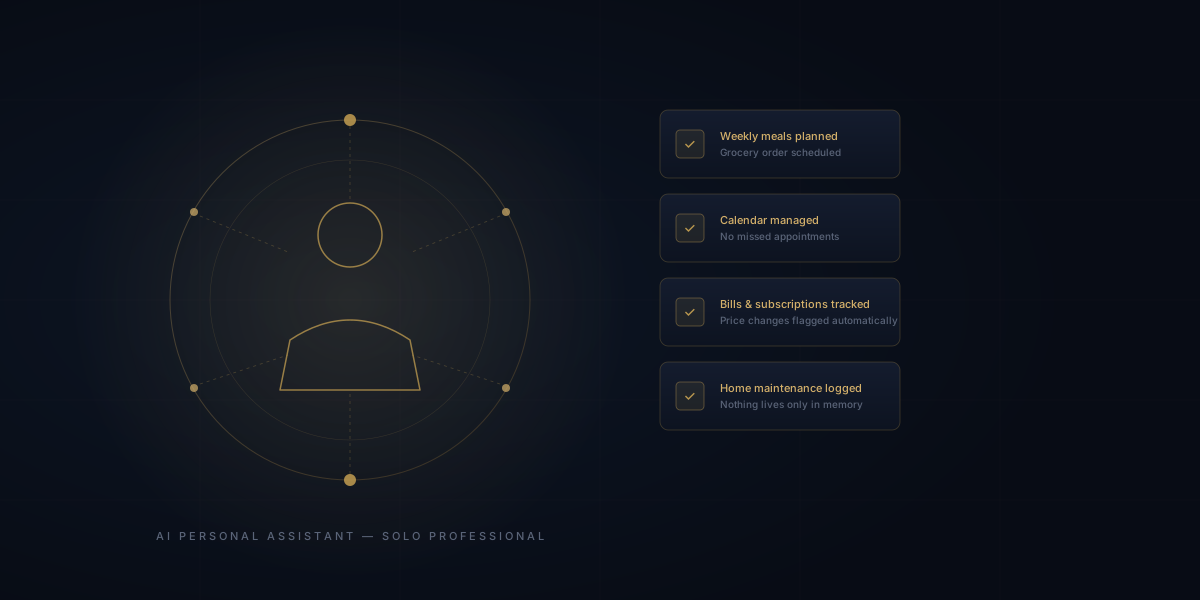
Meal planning becomes automatic. Instead of staring into the fridge wondering what to cook, an AI butler can plan your meals for the week based on your dietary preferences, what is on sale, what is already in your pantry, and what your schedule looks like. It handles the grocery order too, comparing prices across delivery platforms to get the best deal.
Scheduling becomes proactive. Rather than reacting to appointments and deadlines, AI monitors your calendar, suggests optimal times for recurring tasks, and can even book reservations or appointments on your behalf.
The mental inventory disappears. When your AI tracks what you buy, how fast you use it, and when you typically need to restock, you never have to remember to add toilet paper to the list again.
Decision fatigue drops to zero. The average adult makes around 35,000 decisions per day. A significant portion of those are mundane household choices. Every decision you offload to a trusted system frees up cognitive resources for the decisions that actually matter.
Reclaiming Your Time
The goal is not to eliminate all household work. Some people genuinely enjoy cooking. Others find satisfaction in a clean home. The goal is to eliminate the work you do not want to do -- the invisible, repetitive, coordination-heavy tasks that drain your energy without giving anything back.
If you could reclaim even half of those 20-30 weekly hours, what would you do with them? That is 10-15 hours a week. Over a year, that is the equivalent of three to four months of full-time work.
Think about what that time is worth. If your hourly rate is $50, the hidden cost of household management is $50,000 to $75,000 per year in lost productivity. Even if you value your leisure time at minimum wage, you are still looking at $15,000 to $23,000 annually.
The Shift Is Already Happening
Early adopters are already using AI to manage their households, and the results speak for themselves. People report saving 8-12 hours per week, experiencing significantly less stress around daily logistics, and -- perhaps most importantly -- having fewer arguments with their partners about who forgot to do what.
This is not about replacing human judgment. It is about removing the friction from the hundreds of small decisions and tasks that no one should have to hold in their head.
Jipsa was built specifically for this problem. As a personal AI butler, it connects to the services you already use -- grocery delivery, restaurant reservations, your calendar -- and handles the coordination layer so you do not have to. No spreadsheets. No shared apps that someone forgets to update. Just a system that quietly keeps your household running while you focus on everything else.
The hidden cost of running a household is real. But it does not have to be permanent.
Let Jipsa handle it for you
The beta is open. Create your account and hand off the logistics of everyday life — free to start, no card required.
Sign Up for BetaFree Download
The AI Home Management Checklist
42 tasks AI can handle for your household — from meal planning to home maintenance. See exactly what to automate first.