Smart Grocery Shopping: How AI Optimizes Your Cart
AI-powered grocery shopping cross-references sales, pantry inventory, and meal plans to build the perfect cart -- saving you money and eliminating waste.
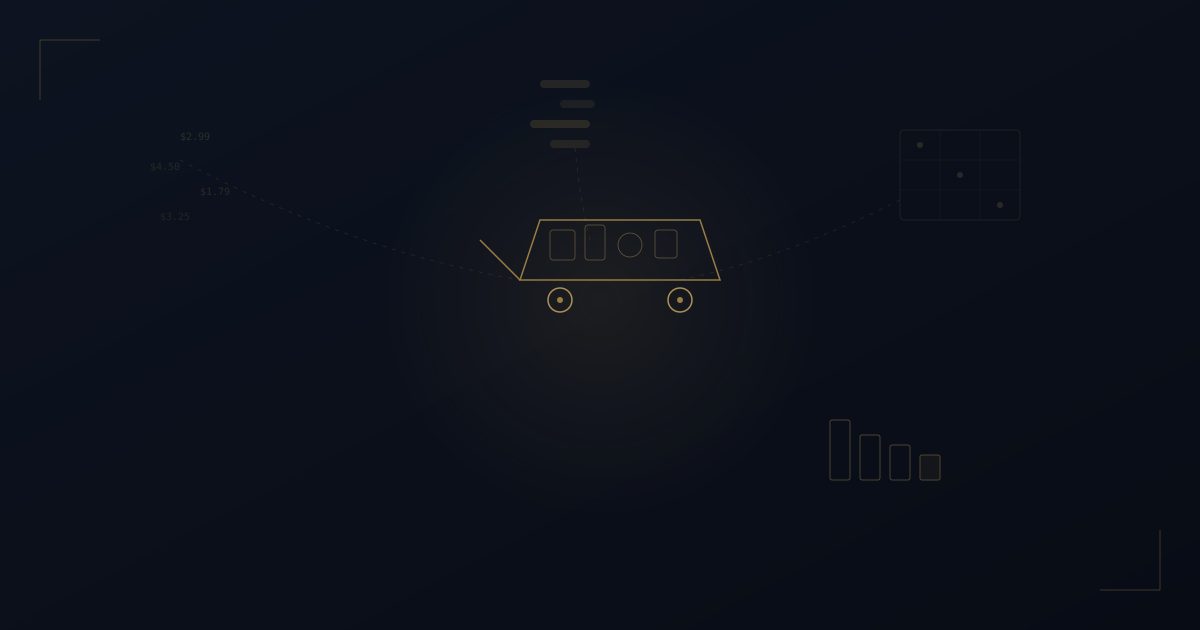
The beta is open — hand this off to Jipsa. Free to start, no card required.
Sign Up for BetaGrocery shopping has not changed much in decades. You check what you need, write a list, go to the store or open an app, and buy what is on the list -- plus a few impulse items you did not plan for. The process is manual, repetitive, and surprisingly expensive when you factor in food waste, missed sales, and duplicate purchases. AI is introducing a fundamentally better approach.
The Problem with How We Shop
The average American household spends approximately $475 per month on groceries. Studies consistently show that 25-30% of that food ends up in the trash. That means families are effectively throwing away $120-140 per month -- over $1,500 per year -- on food that was purchased but never consumed. The full scope of that problem is worth understanding: the real cost of food waste goes well beyond the price tag on the grocery receipt.
The reasons are predictable:
- Over-purchasing: Buying ingredients without a clear plan for using them
- Duplicate buying: Purchasing items you already have because you did not check the pantry
- Ignoring sales cycles: Paying full price for items that were discounted last week or will be next week
- Poor portion planning: Recipes call for half a bunch of parsley, and the rest wilts in the refrigerator
- Impulse additions: Adding items to the cart that were not on the list and often go unused
Each of these problems is solvable. And AI solves them simultaneously.
How AI Optimizes Your Grocery Cart
Smart grocery shopping with AI is not about clipping digital coupons or scanning barcodes. It is a system-level optimization that considers multiple data sources at once to build the most efficient cart possible.
Data Source 1: Your Meal Plan
Everything starts with what you are actually going to cook. An AI-powered system begins with a meal plan -- either one it generated for you or one you provided -- and extracts the exact ingredients and quantities needed. No guessing, no approximation. If you are making chicken tikka masala for four people on Thursday, the system knows you need exactly 1.5 pounds of chicken thighs, one can of crushed tomatoes, and specific spice quantities.
Data Source 2: Pantry Inventory
Before adding anything to the cart, the system checks what you already have. This can work through several mechanisms:
- Purchase history: If you bought a bottle of olive oil two weeks ago and your usage patterns suggest it is not yet empty, it stays off the list
- Manual inventory: A simple interface where you confirm what is on hand after a pantry check
- Smart home integration: Connected pantry systems or barcode scanners that track what enters and leaves your kitchen
The pantry cross-reference alone eliminates an estimated 15-20% of unnecessary grocery purchases. That is real money back in your pocket every month.
Data Source 3: Sales and Promotions
Grocery prices fluctuate constantly. Chicken breasts might be $4.99/lb this week and $3.49/lb next week. Seasonal produce follows predictable cycles. Store loyalty programs offer targeted discounts based on your purchase history.
An AI shopping system monitors these variables and adjusts your cart accordingly. If your meal plan is flexible -- and the system knows which substitutions you accept -- it can swap in sale items without compromising the meal. Pork tenderloin on sale instead of chicken? If your preference profile allows it, the system makes the swap and adjusts the recipe instructions.
Data Source 4: Nutritional Targets
If you have set nutritional goals -- more fiber, less sodium, a protein target -- the AI factors these into cart optimization. It does not just find the cheapest option; it finds the cheapest option that meets your nutritional criteria. This prevents the common trap of optimizing for price alone and ending up with a cart full of processed, nutrient-poor food.
Data Source 5: Waste Prediction
This is where AI truly outperforms human shopping. The system tracks ingredient perishability and your consumption patterns to predict what will go to waste if purchased. If you consistently throw away half a bunch of bananas, it reduces the quantity. If fresh herbs tend to go bad before you use them, it might suggest dried alternatives or plan meals that use them within the first few days.
The Three-Layer Optimization
When all five data sources are combined, the AI performs what amounts to a three-layer optimization:
Layer 1 -- Need: What ingredients are required for your planned meals that you do not already have?
Layer 2 -- Value: Among the needed items, what is the most cost-effective way to purchase them given current sales, store options, and bulk pricing?
Layer 3 -- Waste: Of the items being purchased, which quantities minimize the probability of food going unused?
No human shopper can perform this optimization in real time. It requires cross-referencing too many variables simultaneously. But for AI, it is a straightforward constraint satisfaction problem that takes seconds to solve.
Real-World Savings
The financial impact of AI-optimized grocery shopping is measurable from the first week:
- Week 1-2: 10-15% reduction in grocery spend as duplicate purchases and obvious waste are eliminated
- Month 1: 20-25% reduction as the system learns your consumption patterns and optimizes portion sizes
- Month 3+: 25-35% sustained reduction as sale optimization, seasonal adjustments, and waste prediction fully calibrate
For a household spending $475/month, that translates to $120-165 in monthly savings, or $1,400-2,000 annually. Combined with the time savings of automated ordering, the ROI is immediate and substantial.
Beyond the Cart: The Full Pipeline
Smart grocery shopping does not exist in isolation. It is one component of a fully automated food management system. The pipeline looks like this:
- Meal planning: AI generates a balanced, preference-aligned weekly plan
- Cart optimization: The system builds the most efficient shopping list
- Automated ordering: The order is placed through your preferred delivery service
- Schedule coordination: Delivery time is set for when you are home, prep sessions are blocked on your calendar
- Continuous learning: Every meal cooked, every item wasted, and every preference expressed improves future accuracy
How Jipsa Handles Smart Grocery Shopping
Jipsa integrates the full pipeline into a single experience. Your AI butler does not just suggest groceries -- it manages the entire flow from meal plan to delivered cart.
Connect your preferred grocery delivery service, and Jipsa handles the rest. It builds your meal plan, generates an optimized cart, factors in current promotions, removes items you already have, and places the order. You can review and adjust before checkout, or let the system handle it based on your established preferences.
The result is a grocery process that takes minutes of your attention instead of hours, costs less than manual shopping, and produces almost zero waste. That is not incremental improvement -- it is a fundamentally different way to feed your household.
If you are ready to stop overspending and start optimizing, Jipsa is built to make smart grocery shopping effortless from day one.
Let Jipsa handle it for you
The beta is open. Create your account and hand off the logistics of everyday life — free to start, no card required.
Sign Up for BetaFree Download
7-Day AI Meal Plan Starter Kit
A complete week of dinners with a consolidated grocery list and prep schedule. One trip. Seven meals. Zero guesswork.