AI Personal Assistant for Solo Professionals: Managing Life Without Backup
When you live alone, there is no one to split the mental load with. An AI personal assistant is not a luxury — it is the backup you never had.
The beta is open — hand this off to Jipsa. Free to start, no card required.
Sign Up for BetaEvery productivity article about AI personal assistants is written for couples or families. Split the grocery list. Share the calendar. Divide the household tasks. Great advice, if you have someone to split with.
If you are a solo professional — living alone, running your life independently, answering to no one but yourself and your landlord — the mental load problem is not halved. It is entirely yours. And the AI personal assistant pitch changes completely when you understand it as the backup you have always been missing.
The Solo Professional's Invisible Burden
Living alone is not the same as living simply. You still have:
- A refrigerator that needs stocking and a meal plan that needs to exist somewhere other than "whatever I can make from what is left"
- A calendar that nobody else checks, which means missed appointments are your problem alone
- Bills, subscriptions, renewals, insurance — a financial layer that nobody else notices slipping
- A home that needs maintenance nobody else will schedule
- Logistics that, in a two-person household, get caught by the other person when you drop them
When you have a partner, there is a passive error-correction system operating in the background. They notice you forgot the dry cleaning. They remember the dentist appointment you mentioned forgetting. They pick up the slack on weeks you cannot.
Solo professionals do not have that system. An AI personal assistant for solo professionals fills that exact role — not by replacing human connection, but by providing the operational backup that prevents small oversights from becoming genuine problems.
What the AI Handles That No App Can
The reason typical productivity apps fail solo professionals is the same reason they fail everyone: they require you to maintain them. You have to enter the grocery list. You have to update the calendar. You have to remember to check the budget tracker.
A personal AI assistant like Jipsa works differently. Instead of being a passive container for information you manage, it actively runs the background layer of your life:
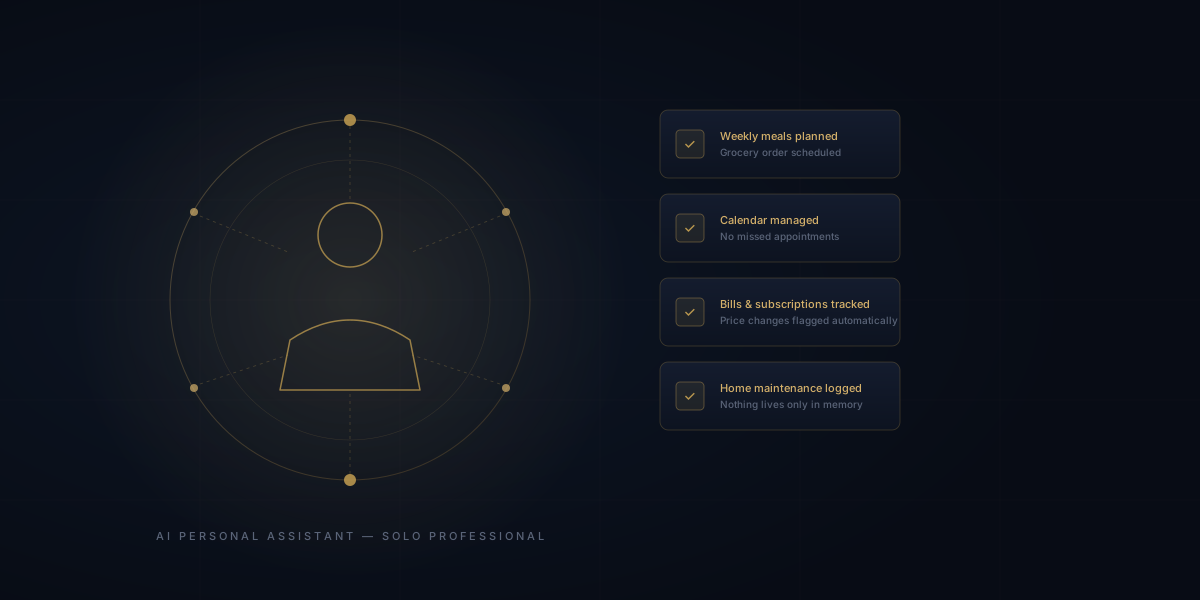
Meals and groceries. Your week's meals are planned based on what you have, what you eat, and what is on sale. Your grocery order is generated automatically. You do not open the app on Sunday evening and stare at a blank canvas.
Calendar intelligence. Jipsa watches your schedule and surfaces what matters — not just reminders, but connections. You have a 9am meeting Monday and usually run out of coffee by Thursday? That is in the weekly order now.
Financial visibility. Every subscription, bill, and recurring charge is tracked. When a price increases or a better rate appears, you hear about it before you notice it on your statement.
Home maintenance. Seasonal checklists, appliance service dates, lease renewal timelines — nothing lives only in your head.
None of this requires a partner. It requires a system that pays attention when you cannot.
The Delegation Problem Solo Professionals Never Solve
In a two-person household, delegation has a natural outlet: you ask the other person. For solo professionals, delegation has nowhere to go. The result is not efficiency — it is quiet accumulation. Tasks pile up not because you are disorganized but because there is only one of you and the list is long.
The mental load research that gets quoted in every productivity article focuses on couples and households with children. But solo professionals carry their own version: the weight of knowing you are the only one who will catch a problem if you do not catch it. No safety net. No second set of eyes. Every logistical ball you drop, you drop alone.
AI personal assistant tools built for individuals — not just as a single seat in a family plan, but genuinely designed for solo management — change the math. You are not eliminating tasks. You are installing a system that catches what you drop.
What a Solo Professional Actually Needs from AI
The specific wins look different from the family use case:
Solo meal planning without waste. Meal planning for one is harder than for four. Scale matters. An AI that understands you cook for one and builds a plan that does not leave you with half a bunch of wilting cilantro is genuinely useful in a way generic meal planning apps are not.
Accountability without a partner. Jipsa sends you the morning briefing, surfaces what needs attention today, and follows up on outstanding items. Not because you asked it to in the moment — because it knows your week.
Proactive financial catch. With no second set of eyes on the finances, you need something that checks. Jipsa tracks your subscriptions, flags anomalies, and surfaces the stuff you did not notice.
The maintenance memory. You changed the water filter last March. You scheduled HVAC service for the fall. These facts live somewhere other than your fallible working memory.
The Real Argument for AI When You Live Alone
The marketing for AI personal assistants often positions the product as a luxury for busy families. It is not. For solo professionals, it is closer to a utility.
You are already doing everything yourself. The question is whether you are doing it with a system that catches what slips or whether you are relying entirely on your own memory and attention — both of which are finite. For solo professionals, those resources are already fully allocated by work, social life, and the hundred small decisions that constitute running an adult life independently.
The time argument applies here with particular force. A solo professional running a household manually spends an estimated four to six hours per week on logistics — grocery planning, meal decisions, bill management, scheduling, home maintenance. That is four to six hours spent on work your AI assistant could handle autonomously.
Ready to stop being the only system in your life? Try Jipsa free — no card required.
Getting Started
The setup for a solo household is faster than for a family. There are no preferences to reconcile, no partner's schedule to integrate, no children's dietary restrictions to account for.
You tell Jipsa the basics — how you eat, how you spend, what your schedule looks like — and it starts running. Within a week, the first changes show up: a morning briefing that actually matches your day, a grocery order you did not have to think about, a subscription flagged for review.
Within a month, you stop catching certain things yourself because you know Jipsa will catch them.
That is the difference. Not efficiency. Not optimization. A system that operates in the background so your working memory can focus on the things that actually require you.
If you have been waiting for an AI personal assistant designed for how you actually live — not for the family version of your life that does not apply — the beta is open now.
Start using Jipsa free — no card required.
Discover more: What an AI butler actually does and the case for stopping managing everything yourself.
Let Jipsa handle it for you
The beta is open. Create your account and hand off the logistics of everyday life — free to start, no card required.
Sign Up for BetaFree Download
The AI Home Management Checklist
42 tasks AI can handle for your household — from meal planning to home maintenance. See exactly what to automate first.