How Couples Use AI to Stop Fighting About Dinner
The nightly dinner debate is a common source of relationship friction. Here is how AI meal planning quietly solves one of modern life's most annoying problems.

The beta is open — hand this off to Jipsa. Free to start, no card required.
Sign Up for BetaIt starts innocently enough. One person asks, "What do you want for dinner?" The other says, "I don't know, what do you want?" Twenty minutes later, nobody has decided anything, someone is getting hangry, and a perfectly good Tuesday evening is deteriorating into a passive-aggressive standoff.
If this sounds familiar, you are not alone. A 2023 survey by OnePoll found that the average couple spends 132 hours per year arguing about what to eat. That is more than five full days of your life, every year, spent on a decision that will be irrelevant in two hours.
The dinner question is not really about dinner. It is about decision fatigue, unequal labor, and the quiet resentment that builds when the same person always has to be the one with a plan.
Why Dinner Is the Flashpoint
Psychologists have a term for this: decision fatigue. By the end of a workday, your brain has already made thousands of decisions. The last thing it wants to do is evaluate whether you are in the mood for Thai or Italian while simultaneously considering what ingredients are in the fridge, whether you have time to cook, and what you ate yesterday.
But the dinner question hits a nerve for a deeper reason. In most relationships, one partner tends to become the "default planner" -- the person who tracks groceries, remembers preferences, and ultimately makes the call when nobody else will. Over time, this creates an imbalance. The planner feels unsupported. The non-planner feels like every suggestion they make gets shot down.
It is not really about the food. It is about the weight of being the person who always has to decide.
The "I Don't Care" Trap
There is a specific pattern that couples fall into, and it goes like this:
Partner A: "What should we eat tonight?" Partner B: "I don't care, whatever you want." Partner A: "How about pasta?" Partner B: "We just had pasta." Partner A: "Okay, tacos?" Partner B: "Eh, I'm not really feeling tacos."
Partner B clearly does care. They just do not want to do the cognitive work of generating options. They would rather play defense -- vetoing ideas -- than play offense by coming up with a plan.
This is not a character flaw. It is a predictable result of decision fatigue. Vetoing requires far less cognitive effort than creating. But for Partner A, it feels like being set up to fail.
How Couples Are Actually Solving This
Some couples try rotating who picks dinner. Others maintain shared Pinterest boards of recipes. A few brave souls plan an entire week of meals in one sitting. These solutions work for a while, but they all require ongoing effort from at least one person, which means they eventually break down.
The couples who have actually solved the dinner problem have done something different: they have removed the decision from the relationship entirely.
This is where AI comes in, and not in the way you might expect.
The solution is not a recipe app. Recipe apps still require you to browse, choose, and plan. The solution is a system that already knows your preferences, already knows what is in your kitchen, already knows your schedule, and simply tells you what is for dinner.
Not suggests. Tells.
The AI Butler Approach
Here is how it works in practice with a tool like Jipsa:
Over time, the AI learns that Partner A loves spicy food but Partner B has a lower tolerance. It knows you both enjoy Mediterranean. It knows Tuesday nights are busy, so dinner needs to be quick. It knows you ordered sushi delivery last Thursday, so it will not suggest that again so soon.
On Monday evening, instead of the dreaded question, you get a notification: "Tonight's dinner: lemon herb chicken with roasted vegetables. Estimated prep time: 25 minutes. All ingredients are in your fridge from Saturday's grocery delivery."
No negotiation. No vetoing. No resentment. If either person does not feel like the suggestion, they can simply ask for an alternative, and the AI generates one instantly. The emotional weight is gone because the "decision maker" is no longer a person.
Why This Actually Helps Relationships
It might sound trivial to say that automating dinner decisions can improve a relationship. But relationship therapists have been saying for years that it is rarely the big issues that erode partnerships. It is the accumulation of small, daily friction points.
Dr. John Gottman, one of the most cited researchers in relationship psychology, found that the strongest predictor of relationship failure is not conflict itself but the ratio of positive to negative interactions. His research suggests you need five positive interactions for every negative one to maintain a healthy relationship.
Every evening dinner argument is a negative interaction. Remove it, and you shift the ratio. Multiply that across every small household decision -- what to buy, when to schedule, what to cook -- and you start to see a meaningful change.
Couples who use AI for household management report two consistent outcomes. First, they argue less about logistics. Second -- and this is the surprising one -- they report feeling more connected. When you are not spending your limited evening hours negotiating chores and meals, you actually have time and energy for each other.
Beyond Dinner: The Compound Effect
Dinner is just the most visible symptom. The same dynamic plays out with grocery shopping ("You forgot the milk again"), scheduling ("I thought you were booking the restaurant"), and every other shared responsibility.
When couples deploy an AI assistant to manage these friction points, the compound effect is significant. One user described it as "removing the operating system of arguments from our relationship." The tasks still get done. The groceries still arrive. The reservations still get made. But nobody has to be the project manager of the household anymore.
Getting Started Without the Awkward Conversation
One of the best things about AI household management is that it does not require a difficult relationship conversation. You do not need to sit down and divide chores or negotiate who plans what. You just start using the tool, and the friction quietly disappears.
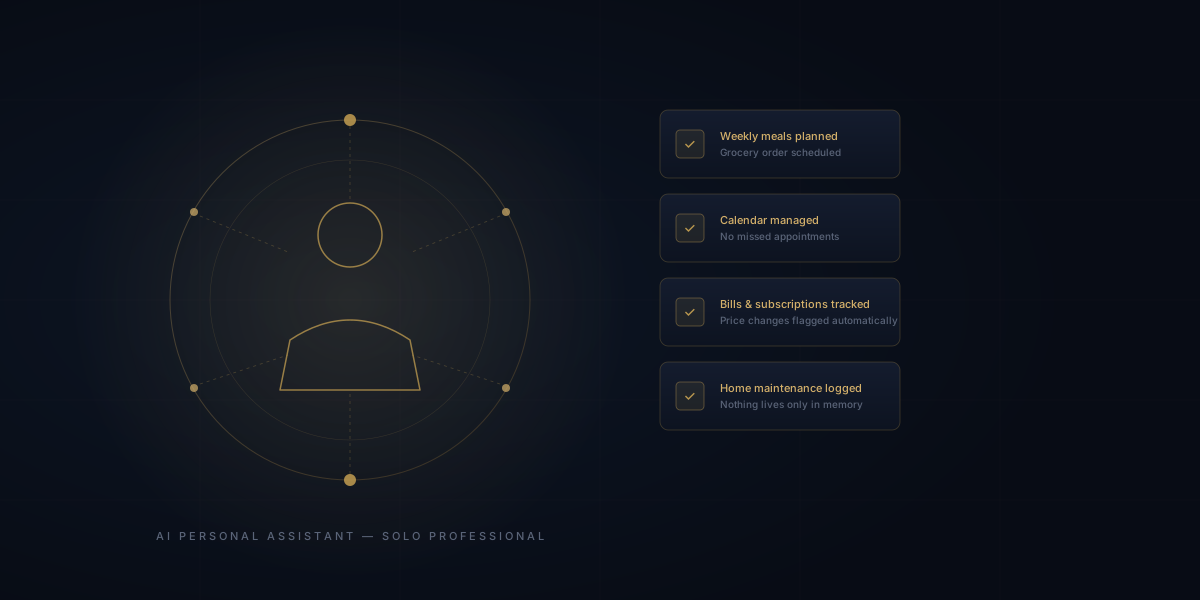
Jipsa works exactly this way. It connects to your grocery delivery accounts, your calendar, and your dining preferences, then starts handling the decisions that neither of you wants to make. Both partners can interact with it, add preferences, or override suggestions. But the default planner is no longer a person -- it is the AI.
The couples who stop fighting about dinner are not the ones who found the perfect communication strategy. They are the ones who realized the fight was never really about dinner in the first place. It was about the burden of deciding. Remove the burden, and the fight goes with it.
Your Tuesday evenings deserve better.
Let Jipsa handle it for you
The beta is open. Create your account and hand off the logistics of everyday life — free to start, no card required.
Sign Up for BetaFree Download
The AI Home Management Checklist
42 tasks AI can handle for your household — from meal planning to home maintenance. See exactly what to automate first.