How to Delegate Your Household Tasks to AI
You delegate at work. Here is how to delegate at home — and why an AI butler handles household logistics better than any app or spreadsheet.
The beta is open — hand this off to Jipsa. Free to start, no card required.
Sign Up for BetaYou would never run a company by doing every task yourself. You hire, you delegate, you build systems. Yet most people run their households like a solo founder who refuses to let go — personally managing every grocery list, every appointment, every bill, every decision about what to have for dinner on a Tuesday.
Delegating household tasks to AI is not about laziness. It is about applying the same logic that makes organizations scale: the person at the top should focus on decisions that matter, not on repeatable logistics that drain their energy before the real work begins.
Why Traditional Delegation Fails at Home
You have tried the apps. The shared calendars. The meal planning spreadsheets. Maybe you even hired a virtual assistant for a few months. Each one solves a narrow problem while creating new overhead — another login, another system to maintain, another thing to check.
The issue is not a lack of tools. It is that household management is a web of interconnected tasks, not a list of independent items. Your grocery list depends on your meal plan. Your meal plan depends on your schedule. Your schedule depends on what your partner committed to and whether the kids have practice. No single-purpose app handles that chain.
Traditional delegation also fails because it requires you to be the manager. You still have to assign, follow up, verify, and course-correct. That is not delegation — it is supervision with extra steps.
What Real Delegation Looks Like
Real delegation means handing over both the task and the thinking behind it. When you delegate effectively at work, you do not dictate every step. You communicate the outcome you want, share relevant context, and trust the system to execute.
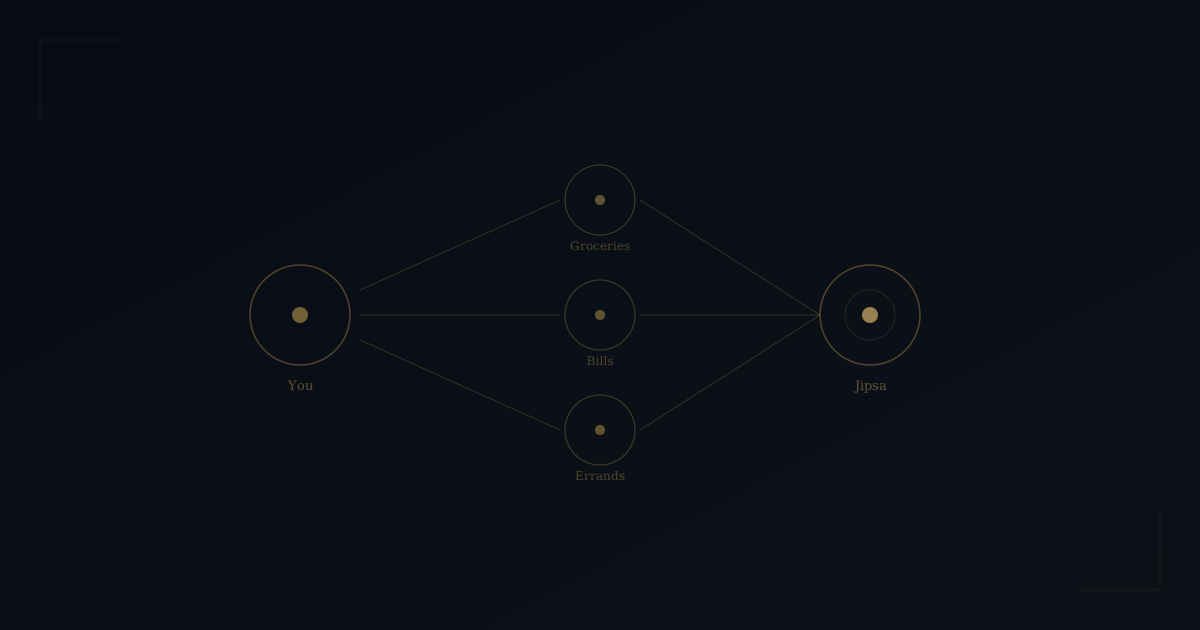
That is exactly how an AI butler operates. You tell it your household's dietary restrictions, your preferred grocery store, your budget parameters, and your weekly rhythm. From there, it handles the chain: plan meals, generate the grocery order, account for what is already in your pantry, and place the order at the right time.
You are not managing it. You are not checking on it. You set the parameters once, and the system runs.
The Three Levels of Household Delegation
Not every task is ready to be fully automated. Think of delegation as a spectrum:
Level 1 — Assisted. The AI does the research and drafts a plan. You review and approve. Good for high-stakes decisions like booking travel or planning a dinner party. Jipsa handles this through its event planning and travel features.
Level 2 — Supervised. The AI executes the task and notifies you after. You spot-check occasionally but do not intervene unless something looks off. Weekly meal plans and grocery orders fit here perfectly.
Level 3 — Autonomous. The AI handles the task end-to-end with no input needed. Recurring bill tracking, subscription management, and calendar maintenance all belong at this level once you trust the system.
The goal is to move tasks up this ladder over time. Start supervised. Build confidence. Then let go.
The Tasks You Should Delegate First
Not all household tasks are equal. Start with the ones that are high-frequency, low-creativity, and high-friction — the tasks that eat your time without giving anything back.
Meal Planning and Grocery Management
This is the single highest-impact area to delegate. Most households spend 3-5 hours per week on the meal planning cycle: deciding what to eat, checking what you have, making a list, shopping or ordering, and adjusting when plans change. An AI butler compresses this to 30 seconds of oversight.
Bills, Subscriptions, and Financial Logistics
You should not be manually tracking when bills are due or which subscriptions auto-renewed. These are pattern-based, recurring tasks — exactly what AI handles best. The hidden cost of managing your household is largely financial admin that could run on autopilot.
Calendar Coordination
If you live with anyone — partner, roommates, family — calendar coordination is a constant negotiation. Who is picking up the kids. When the plumber is coming. Whether Thursday night is free. An AI that sees everyone's schedule and proactively flags conflicts removes an entire category of household friction.
Home Maintenance Scheduling
Furnace filters. Gutter cleaning. Smoke detector batteries. These tasks are infrequent enough to forget but important enough to cause problems when you do. A seasonal maintenance system handles the reminders and scheduling so you never think about it.
How to Start Delegating to Jipsa
The practical steps are simpler than you expect.
Step 1 — Connect Your Services
Link your calendar, grocery delivery, and any other services you use daily. Each connection gives Jipsa the ability to act, not just advise. This is what separates a real AI butler from a chatbot — it connects to your actual life.
Step 2 — Share Your Preferences
Tell Jipsa about your household. Dietary needs, budget ranges, scheduling preferences, recurring commitments. The more context you provide upfront, the less correction you will need later. This is the same principle behind any good delegation: clear context produces better outcomes.
Step 3 — Start With One Domain
Do not try to automate everything at once. Pick one area — meal planning is the most common starting point — and let Jipsa run it for a full week. Review the results. Adjust preferences if needed. Then add the next domain.
Step 4 — Move Up the Delegation Ladder
As you build trust in the system, shift tasks from supervised to autonomous. Most Jipsa users reach Level 3 on grocery ordering within two weeks. Morning briefings and calendar management follow shortly after.
The Mental Load Argument
Delegation is not just about saving hours. It is about reclaiming the cognitive bandwidth that household management silently consumes. The mental load of tracking dozens of small responsibilities — did we pay that bill, are we out of paper towels, when does the dog need her next vet visit — fragments your attention throughout the day.
When you delegate that load to a system that genuinely handles it, the result is not just free time. It is a clearer mind. You stop carrying the invisible weight of household logistics, and the difference is immediate.
Why AI Delegation Works Better Than Human Delegation
A human assistant forgets. Calls in sick. Needs training. Costs $25-50 per hour. An AI butler runs 24/7, remembers every preference you have ever shared, never needs a day off, and improves as it learns your patterns.
This is not a knock on human assistants — for complex, judgment-heavy tasks, humans are irreplaceable. But for the repeatable logistics of running a household, AI is simply a better fit. It does not get bored. It does not cut corners on the fifteenth grocery order. It treats the mundane with the same consistency every single time.
Start Delegating
You already know how to delegate. You do it professionally every day. The only shift is applying that same instinct to your home life — and choosing a system built to handle it.
Jipsa is that system. Try it for free and start with the one task that drains you most. You will wonder why you waited.
Let Jipsa handle it for you
The beta is open. Create your account and hand off the logistics of everyday life — free to start, no card required.
Sign Up for BetaFree Download
The AI Home Management Checklist
42 tasks AI can handle for your household — from meal planning to home maintenance. See exactly what to automate first.