AI Personal Assistant vs Virtual Assistant: Which One Wins
AI personal assistant vs virtual assistant — the real differences in cost, capability, and reliability for managing your household in 2026.
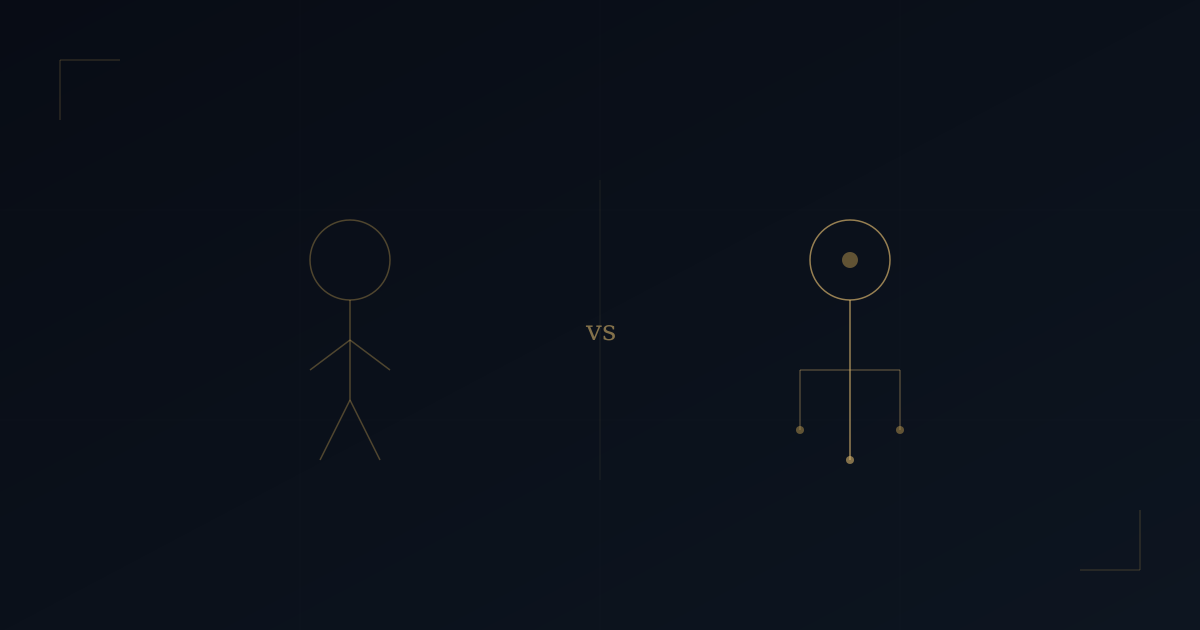
The AI personal assistant vs virtual assistant debate has reached an inflection point. For years, the choice was simple: hire a human VA for hands-on tasks, use Siri or Alexa for timers and trivia. But AI agents that take real action — booking, planning, purchasing, coordinating — have collapsed the gap between the two. If you are deciding where to invest your time and money, here is what actually matters.
Defining the Two Categories
A virtual assistant is a human being. They work remotely, handle tasks you delegate, and charge by the hour or month. Good ones are worth every dollar. The best ones become indispensable.
An AI personal assistant is software that manages recurring tasks autonomously. Not a chatbot. Not a voice command interface. A system that learns your preferences, monitors your calendar, plans your meals, tracks your budget, and handles logistics without being asked twice.
The distinction is not about quality. It is about operating model.
Cost: The Math Nobody Shows You
A competent virtual assistant costs $25 to $50 per hour in North America, or $8 to $15 per hour offshore. At 10 hours per week, that is $1,000 to $2,000 per month domestically. Even offshore, you are looking at $320 to $600 monthly before you account for onboarding time, communication overhead, and the management tax of keeping another person productive.
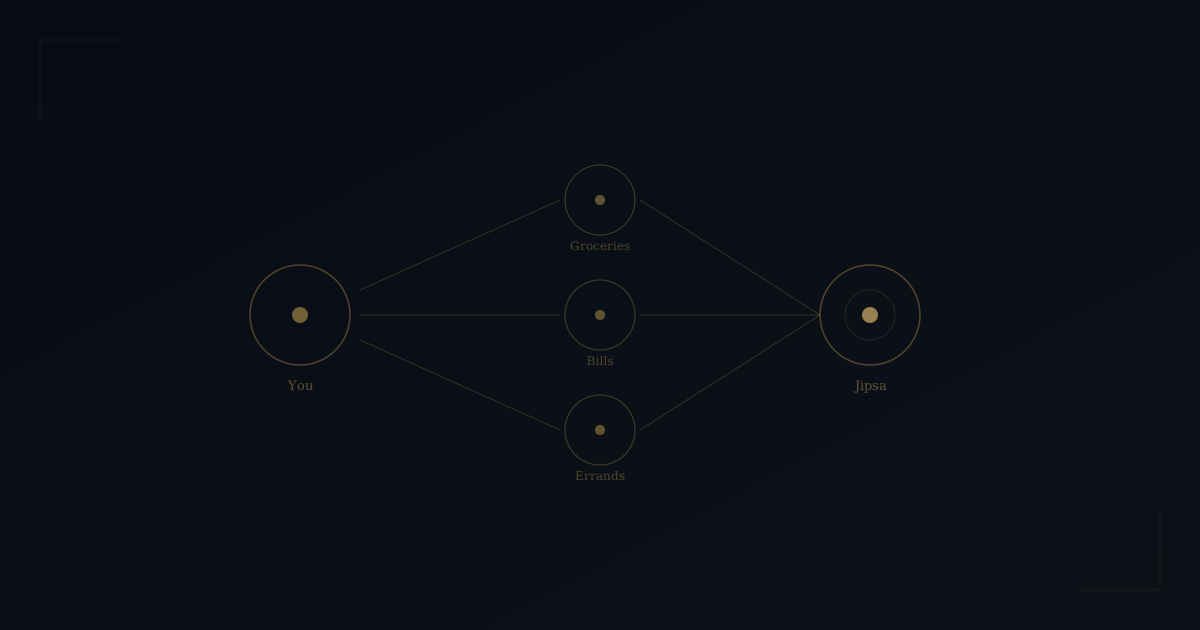
An AI personal assistant like Jipsa costs a flat monthly fee — typically $15 to $50 — with no hourly variance, no scheduling constraints, and no sick days. It operates 24/7 and handles tasks in seconds that would take a human assistant 20 minutes of context-switching.
For households spending under $500 a month on delegation, the AI option is not just cheaper. It is a different category of economics.
Capability: Where Each One Excels
What a Virtual Assistant Does Better
Human VAs excel at tasks requiring judgment in ambiguous situations, emotional intelligence, and physical-world actions. If you need someone to return a package at the post office, negotiate with a contractor, or make a phone call on your behalf, a human wins.
They are also better at one-off tasks that require deep research and subjective evaluation — finding the perfect anniversary gift when "she likes experiences more than things" is the only brief.
What an AI Personal Assistant Does Better
AI personal assistants dominate in three areas: speed, consistency, and scale.
Meal planning for a family of four with dietary restrictions, cross-referenced against your pantry inventory, with a grocery order placed automatically? That takes Jipsa about 30 seconds. A human VA needs 45 minutes and will still miss that you already have three cans of chickpeas.
Budget tracking that updates in real time, flags anomalies, and adjusts projections weekly? The AI does this passively. A human VA does this reactively, after you ask.
Recurring tasks — the weekly meal plan, the monthly home maintenance check, the daily calendar brief — are where AI assistants deliver the most value. They never forget, never need reminding, and never lose context between sessions.
Reliability: The Hidden Variable
Virtual assistants are human. They get sick, take vacations, change jobs, and have bad days. Every VA relationship carries transition risk — the moment they leave, their institutional knowledge of your preferences walks out with them.
AI assistants do not have this problem. Your preferences, history, and patterns persist indefinitely. There is no onboarding period when you "switch" — because you never switch. The system is always current.
The tradeoff: AI assistants can fail at edge cases that a human would navigate intuitively. If the restaurant you wanted is fully booked, a human VA might call to sweet-talk the host. An AI will suggest alternatives. Both are useful. They are different kinds of reliable.
The Hybrid Approach
The smartest households in 2026 are not choosing one or the other. They are using AI personal assistants for the 80% of tasks that are recurring, structured, and preference-driven — and reserving human help for the 20% that requires genuine judgment or physical presence.
This is exactly the model Jipsa was built for. Handle the operational overhead of running a household automatically, so the hours you do spend with a human assistant (or on your own) go toward things that actually need a human touch.
What to Ask Before Choosing
Before you commit to either path, answer these questions:
How much of your delegation is recurring? If more than half your tasks repeat weekly or monthly, an AI assistant will outperform a human one on those tasks — every time.
How much management overhead can you absorb? Human VAs require management. You are trading execution time for management time. If you are already at capacity, adding a person to manage may not reduce your load.
What is your budget ceiling? Below $100 per month, a human VA is not viable for meaningful coverage. An AI assistant delivers comprehensive coverage at that price point.
Do you need physical-world action? If yes, you need a human — or a hybrid model. AI cannot pick up your dry cleaning. Yet.
The Verdict
The AI personal assistant vs virtual assistant question is not really a competition. It is a workflow design decision. AI handles volume, consistency, and speed. Humans handle nuance, physicality, and improvisation.
For most households, starting with an AI personal assistant and adding human help selectively is the highest-leverage approach. You get 24/7 coverage on the operational grind, preserve your budget for tasks that genuinely need a person, and eliminate the management overhead of a full-time delegation relationship.
Jipsa was built for exactly this — to be the AI layer that handles the relentless operational work of running a household, so you spend your time and money where they matter most.
Ready to see the difference? Start with Jipsa today and let it handle what a spreadsheet and a to-do list never could.
Free Download
The AI Home Management Checklist
42 tasks AI can handle for your household — from meal planning to home maintenance. See exactly what to automate first.
Ready to let Jipsa handle this for you?
Try Jipsa while it's still in beta — free to use.